
Waves that clear waste from the brain during sleep are impaired in older adults
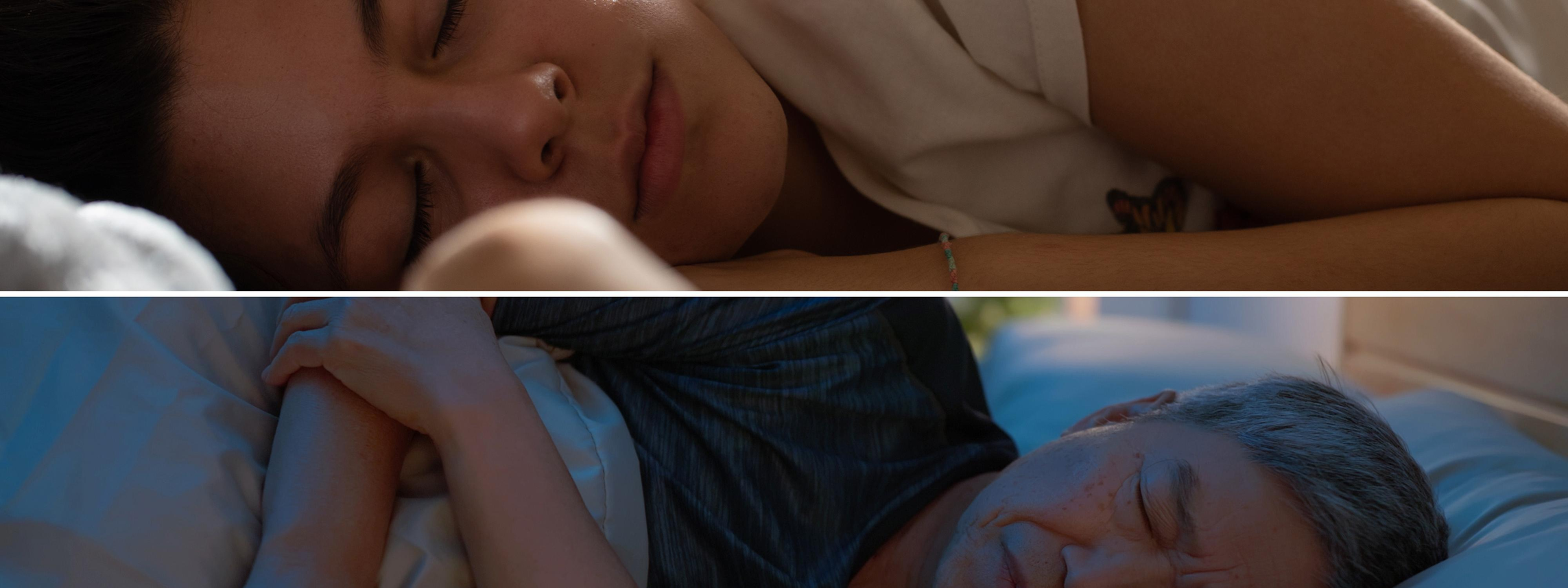
As people age, they may sleep for shorter periods and wake up more frequently during the night. In addition to those disruptions, MIT researchers have now discovered that a process responsible for flushing waste from the brain during sleep is commonly impaired in older people.
The researchers found that waves of cerebrospinal fluid (CSF), which help remove debris from the brain, are significantly reduced in older adults. This impairment is linked to a decrease in the slow brain waves that normally occur during deep sleep, the researchers found, and is not just a result of getting less sleep.
The researchers now hope to explore whether the disruption of CSF flow increases the risk of neurodegenerative disorders, and if any of the sleep patterns they observed might offer a way to predict an individual’s risk.
“We know that people age really differently. Some people age very successfully with great cognitive outcomes, and other people develop cognitive decline. If we can figure out who has great trajectories of aging and what are the factors that are associated with that, we might be able to use that to predict future outcomes,” says Laura Lewis, the Athinoula A. Martinos Associate Professor of Electrical Engineering and Computer Science, a member of MIT’s Institute for Medical Engineering and Science and the Research Laboratory of Electronics, and an associate member of the Picower Institute for Learning and Memory.
Her lab also plans to investigate whether there might be any interventions that could improve CSF flow in older adults.
Lewis is the senior author of the study, which appears today in Nature Aging. Sydney Bailes, a postdoc in the MIT Laboratory for Information and Decision Systems, and Stephanie Williams, a former visiting student at MIT who earned her PhD from Boston University in 2026, are the lead authors of the paper.
Smaller waves
During the deepest stages of sleep, also called non-REM sleep, high-amplitude, low-frequency waves contribute to physical recovery, memory consolidation, and many other functions. In a 2019 study, Lewis found that these slow waves are also critical for generating waves of CSF that help flush waste from the brain.
That finding led her to wonder whether reductions in slow waves in older people might also reduce CSF flow. Previous studies of aging have yielded conflicting evidence; some found that CSF flow goes down in older adults, while others found it goes up, but these studies did not monitor flow during sleep.
In the latest study, the researchers recruited volunteers in two age groups: 18 to 39 and 60 to 84. The tests lasted for about two hours and began late at night, so that participants would be sleepy.
The researchers used traditional fMRI to measure participants’ blood flow in the brain, along with a modified MRI technique, developed by Lewis, that measures CSF flow. While the subjects were in the scanner, the researchers also measured their brain waves using EEG.
Many of the participants fell asleep in the scanner, allowing the researchers to compare their brain activity while awake and while sleeping.
As they had seen in earlier work, the researchers found that when the younger adults fell into non-REM sleep, their EEG slow waves became stronger, and their CSF waves became larger. However, in the older group, the average CSF waves were significantly smaller than those seen in the younger group.
Impaired flow
In additional experiments done while subjects were fully awake, the researchers tried to figure out what was causing the age-related declines in CSF flow.
First, they explored the possibility that changes in a phenomenon known as neurovascular coupling might play a role. When localized brain activity increases the demand for oxygen, nearby blood vessels dilate and deliver more oxygen and nutrients. That increase in blood flow can be measured with fMRI.
The researchers tested each subject’s neurovascular coupling by measuring blood flow while the subjects looked at a flickering checkerboard image — a task that typically drives an increase in neural activity, along with an increase in blood volume.
In many of the older subjects, while their neural activity did go up, the blood flow didn’t increase much, suggesting that the blood vessels’ ability to respond to increased oxygen demand has diminished.
During another task, the researchers tested whether the brain’s vascular system might be impaired in the older subjects. They asked the subjects to hold their breath, then measured what happened inside the brain. Normally, this leads to an increase in carbon dioxide levels in the blood, which triggers an increase in cerebral blood flow. However, in the older participants, the average blood flow increase was smaller than the increase seen in the younger subjects.
These two factors — reduced neurovascular coupling and diminished blood flow — accounted for much of the decline in CSF flow but could not explain all of it, according to a statistical model developed by the researchers. This suggests that there may be other age-related factors that contribute to the reduction in CSF flow, they say.
“Aging is so complex, and so many different things change, that it’s really hard to disentangle the individual factors,” Bailes says. “We try to account for some of the mechanisms, but there definitely are a lot of other factors related to vascular health and lifestyle. If you were able to measure all of them, you might be able to break it apart into different explanations for why an individual’s CSF flow might be more or less impaired.”
Enhancing CSF flow
Previous studies have found that sleep disturbances are linked to a greater risk of neurodegenerative disorders such as Alzheimer’s and other forms of dementia.
None of the subjects in this study had been diagnosed with a neurodegenerative disorder, but the researchers found that some of the older adults showed signs of gray matter atrophy, which was correlated with a greater decrease in CSF flow. They hope to continue studying some of the participants in hopes of discovering whether changes to CSF flow are associated with a higher risk of developing a neurodegenerative disorder.
They also hope to test possible interventions that might help increase CSF flow. In a recent study, Lewis’ lab found that short bursts of “pink noise” during sleep could increase CSF flow in younger adults, but they have not yet tested that intervention in older adults.
In other work, they plan to study why some older adults don’t experience a dropoff in CSF flow. In this study, the researchers found that while as a group, older adults showed weaker CSF waves during sleep, some individuals in the group maintained normal CSF waves.
“It’s really intriguing that for some of these older adults, their CSF fell right in the range of the healthy young adults,” Lewis says. “We are really interested in what’s different in those people and how that might be related to future health outcomes.”
The research was funded by the National Institutes of Health, the Simons Collaboration on Plasticity in the Aging Brain, a McKnight Scholar Award, a Pew Biomedical Scholar Award, an MIT EECS Transformative Research Award, the Picower Institute Neurological Disorder Discovery Research Fund, a Sloan Fellowship, and the Department of Defense National Defense Science and Engineering Graduate Fellowship Program.